We expected a long trek to the top of Mount Whitney. What we got was a grueling footslog that pushed us to the limits.
When we woke up in the wee hours of our big day, we saw something we hadn't seen since we arrived: clear skies.
For days it had been wet weather around Mount Whitney. It was so bad that just the day before, hikers were forced to turn around near the summit because of blizzard conditions. It's not what you want to hear right before your own attempt.
This was an important hike to us. My daughter is named after the mountain, and we'd always hoped to reach the summit together. We trained for months, subjecting ourselves to long hikes on ankle-twisting terrain with heavy packs. But we knew Mother Nature would have the final say.
So to wake up to this view was promising. Energized, my daughter, son Griffin and I began our ascent to 14,505.
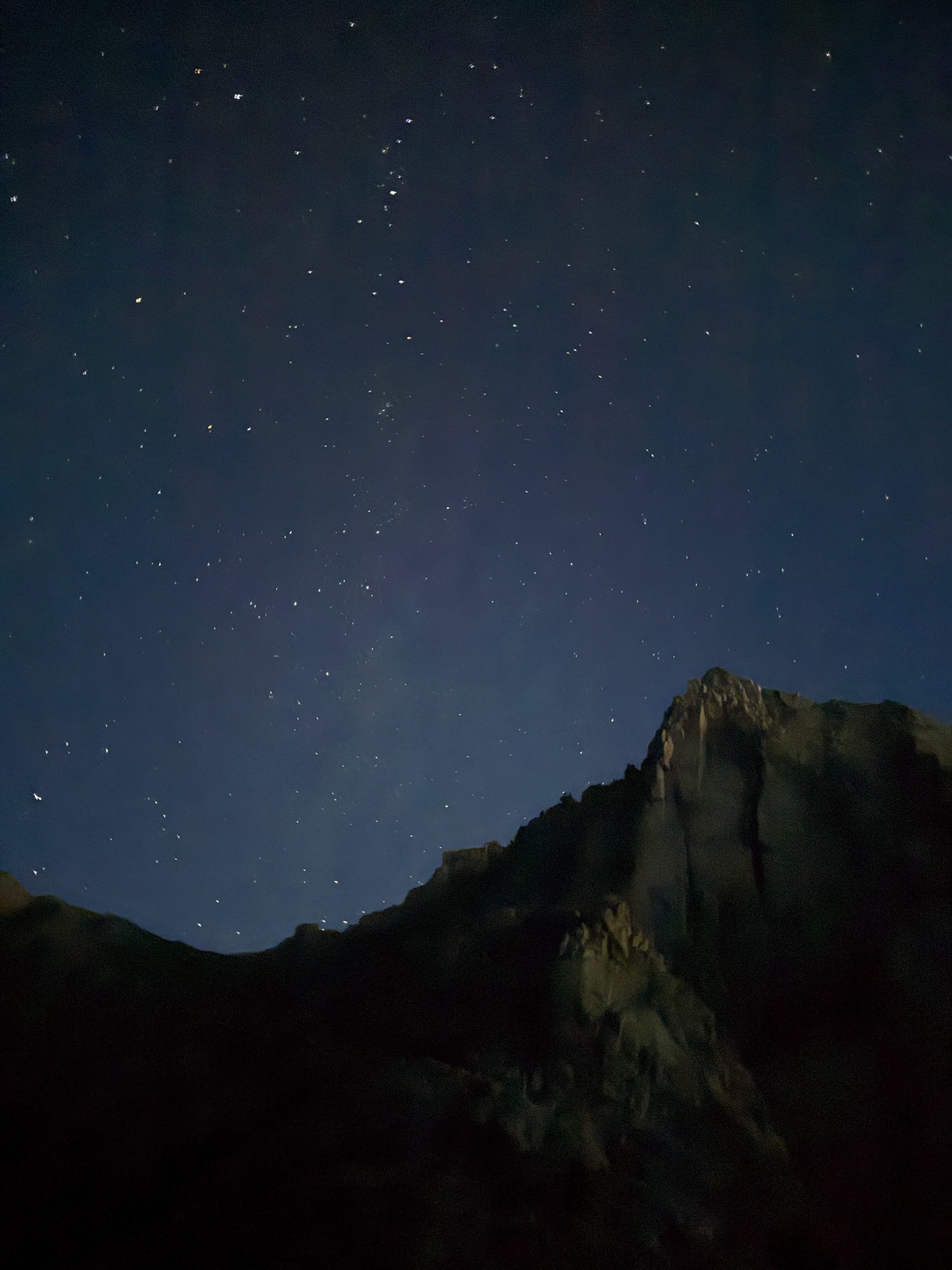
When we woke up in the wee hours of our big day, we saw something we hadn't seen since we arrived: clear skies.
For days it had been wet weather around Mount Whitney. It was so bad that just the day before, hikers were forced to turn around near the summit because of blizzard conditions. It's not what you want to hear right before your own attempt.
This was an important hike to us. My daughter is named after the mountain, and we'd always hoped to reach the summit together. We trained for months, subjecting ourselves to long hikes on ankle-twisting terrain with heavy packs. But we knew Mother Nature would have the final say.
So to wake up to this view was promising. Energized, my daughter, son Griffin and I began our ascent to 14,505.
There's nothing technically difficult about the main trail when it's free of snow and ice. Still, you have to watch your step on the rocky path, especially at night.
There's little risk of falling off a cliff during the early parts of the hike. But when you climb above 12,000, the drop-offs become steep, the trail can become slippery and you're much more vulnerable to the elements.
(Recently, a hiker stepped off a cliff and suffered brain injury. Another fell to his death amid severe weather conditions. And another hiker just died, possibly while taking a shortcut on the long trail.)
We're early in our hike, up only 8,800 feet.
(To hear the rushing water, unmute in the lower left corner.)
There's nothing technically difficult about the main trail when it's free of snow and ice. Still, you have to watch your step on the rocky path, especially at night.
There's little risk of falling off a cliff during the early parts of the hike. But when you climb above 12,000, the drop-offs become steep, the trail can become slippery and you're much more vulnerable to the elements.
(Recently, a hiker stepped off a cliff and suffered brain injury. Another fell to his death amid severe weather conditions. And another hiker just died, possibly while taking a shortcut on the long trail.)
We're early in our hike, up only 8,800 feet.
(To hear the rushing water, unmute in the lower left corner.)
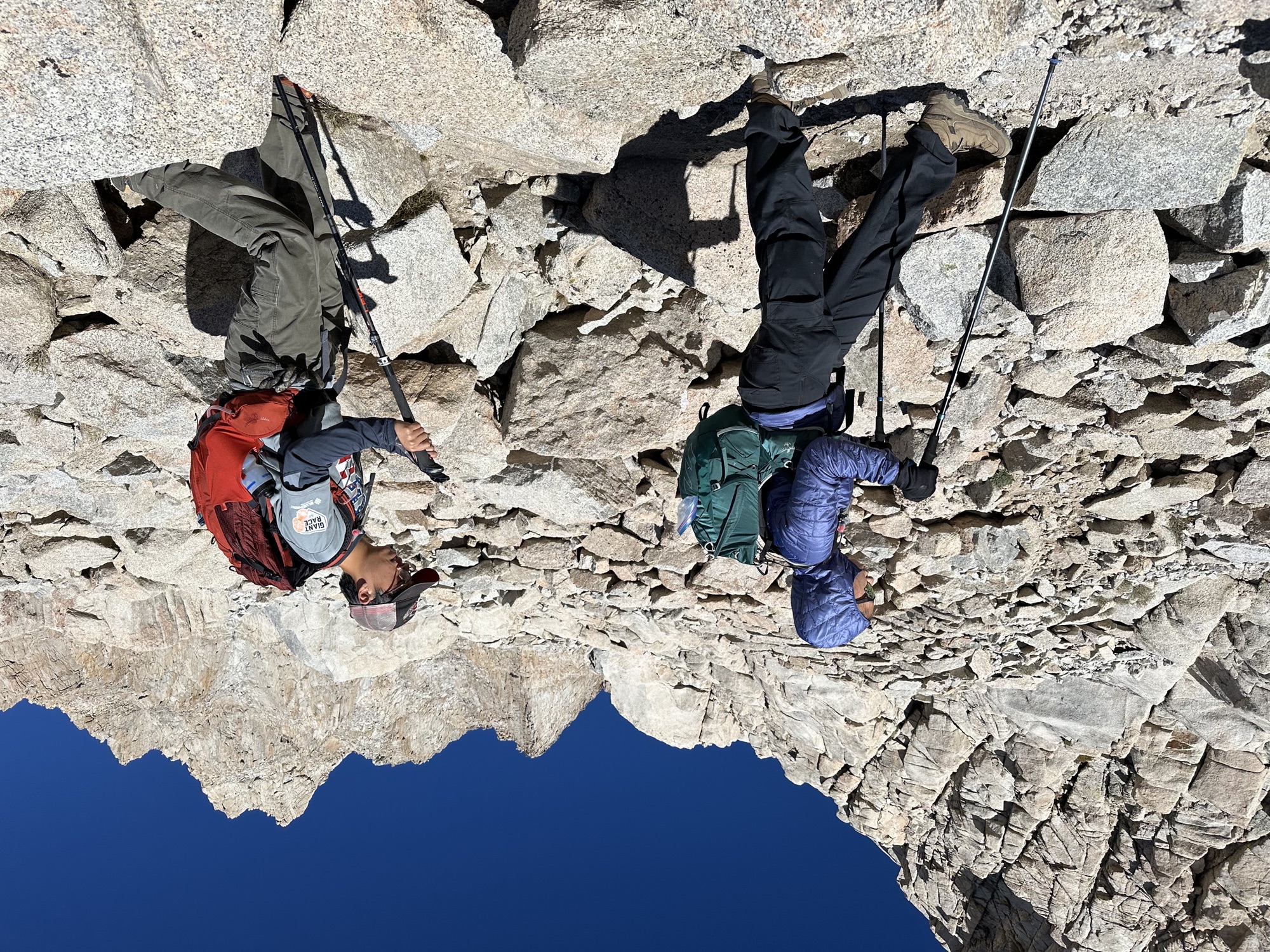
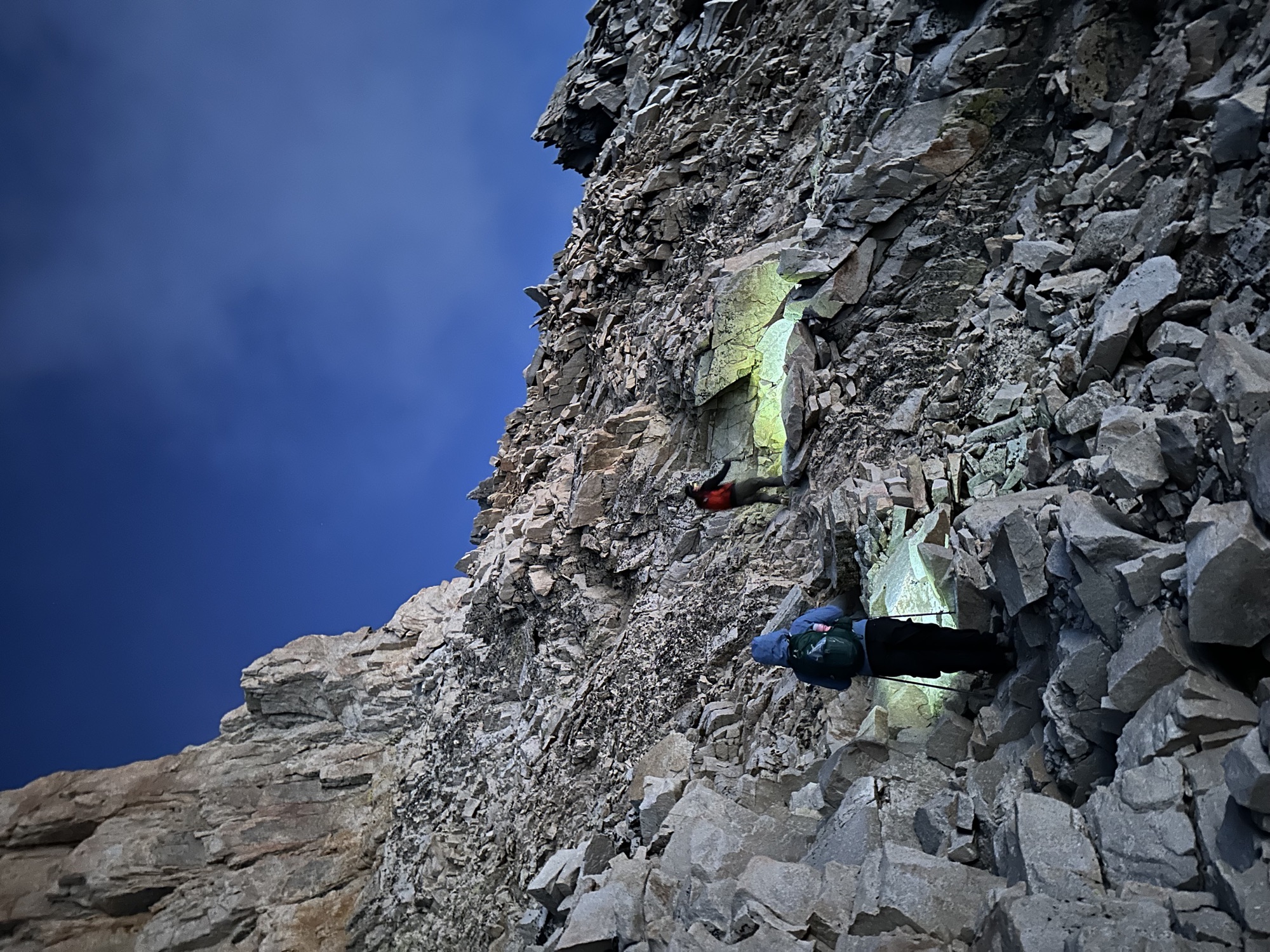
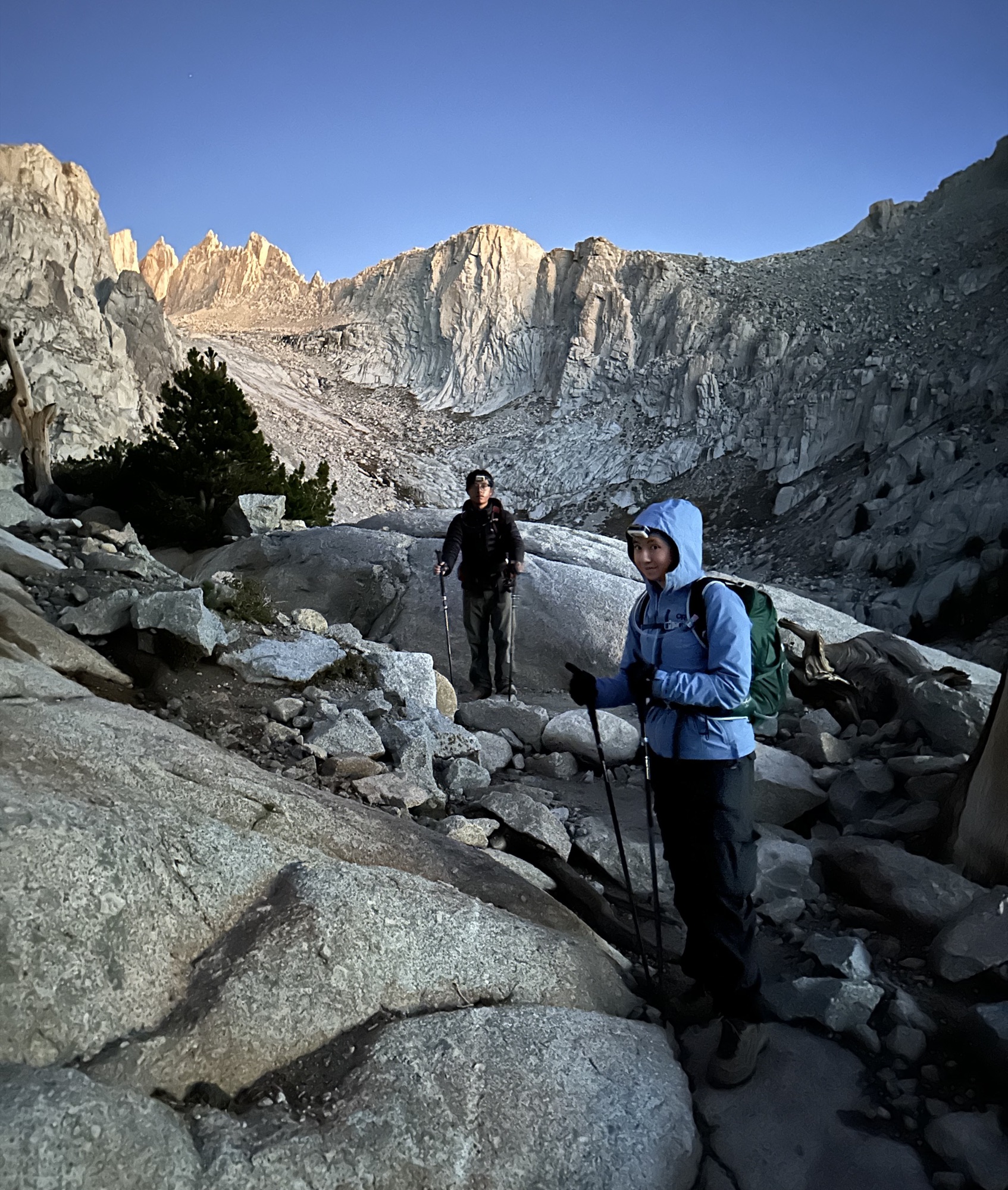
Daylight comes. After hiking for hours by headlamp, the rising sun reveals the hard, jagged landscape we've been traversing. I feel like I've been transported. We're close to 11,000 feet.
We've been moving at a steady pace, but I know Griffin wants to hike faster (because he can). For the sake of the rest of us, he'll have to cool his heels.
Far off in the distance (upper left corner of the photo), we catch our first glimpse of the famous golden hue (or "alpenglow") of the main Mount Whitney massif. That's about 13,000 feet.
It's where we're headed.
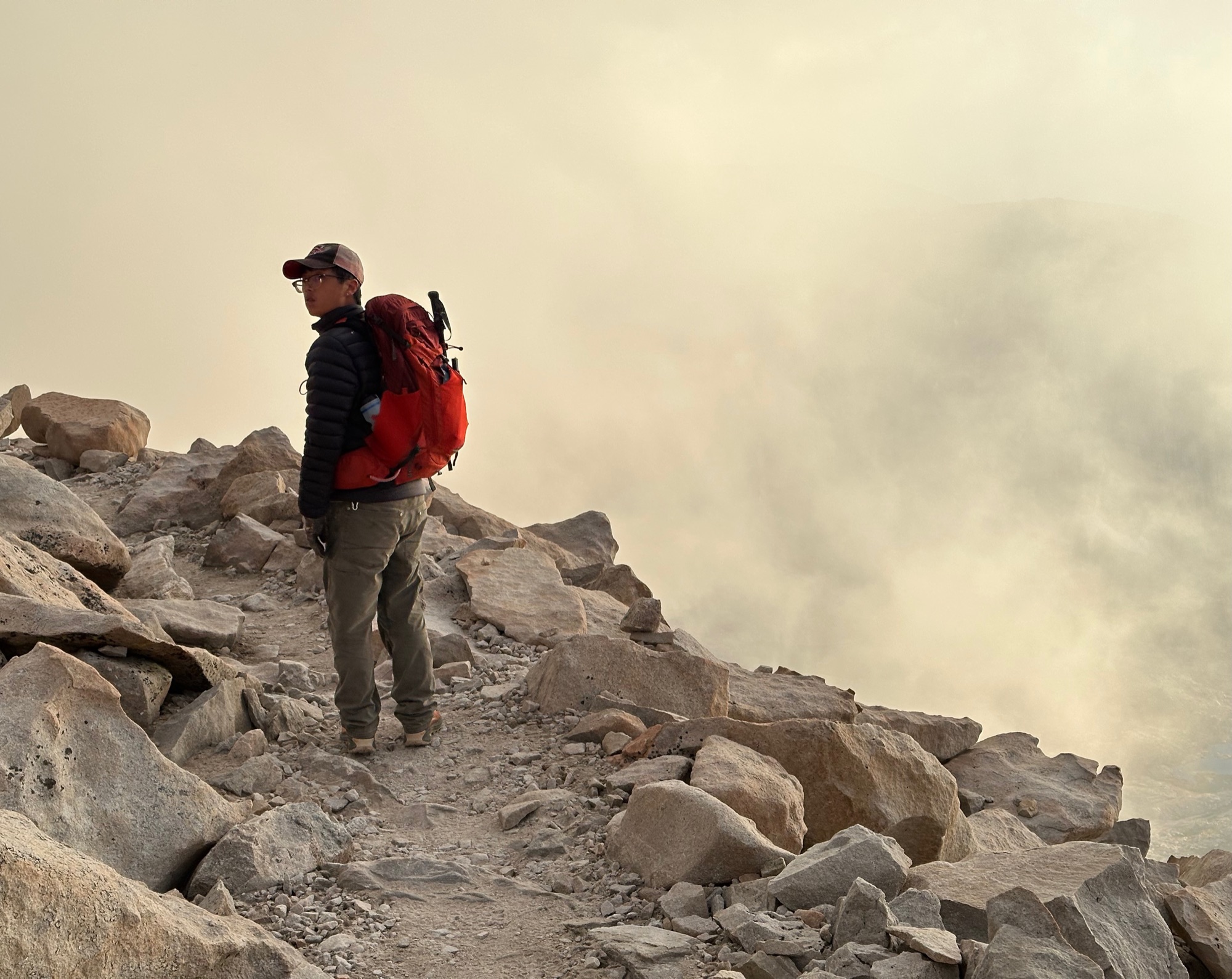
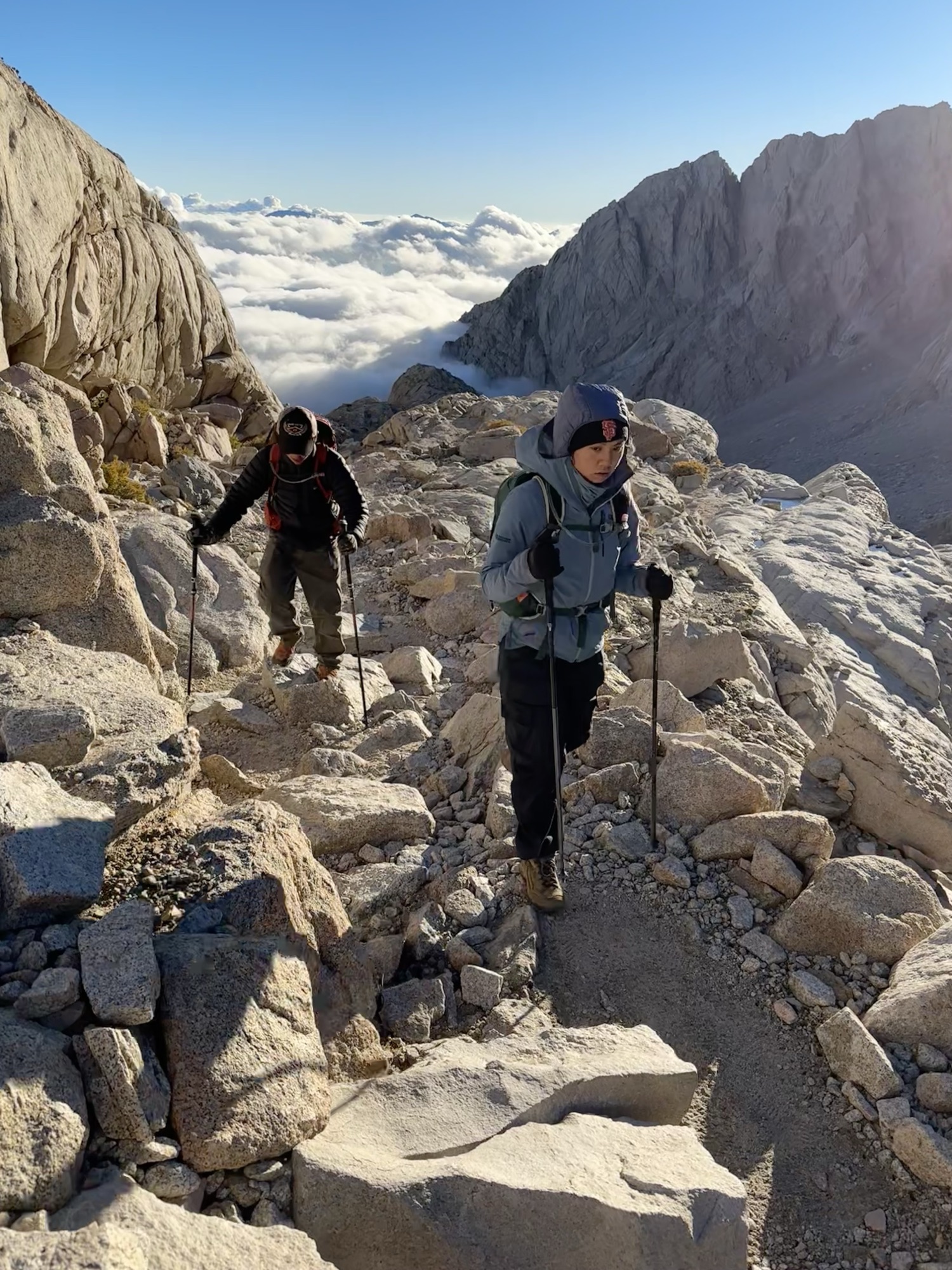
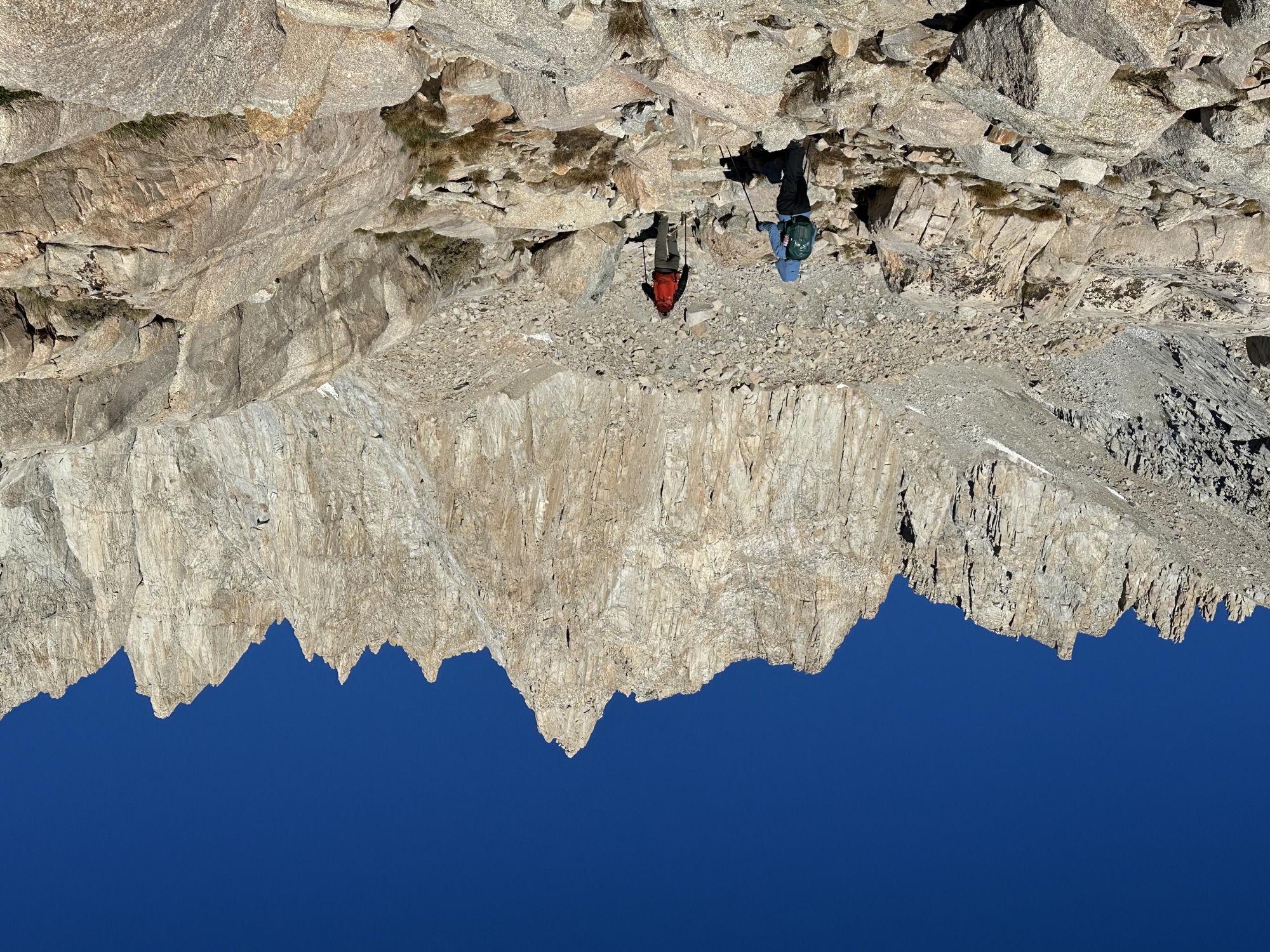
The clear skies didn't last for long. A sea of clouds slowly creeps up behind us. We're at an elevation of around 11,700 feet.
The sun is out, yet it feels colder. The altitude is making us breathe harder.
We run into only one other person on this leg of the trail. It's a tall, young guy who passes us, but then takes a wrong turn, and ends up behind us.
Even though this is a well-worn path, it's not always obvious which way to go. That's why we have GPS-enabled maps on our phones (I'm using FarOut).
Daylight comes. After hiking for hours by headlamp, the rising sun reveals the hard, jagged landscape we've been traversing. I feel like I've been transported. We're close to 11,000 feet.
We've been moving at a steady pace, but I know Griffin wants to hike faster (because he can). For the sake of the rest of us, he'll have to cool his heels.
Far off in the distance (upper left corner of the photo), we catch our first glimpse of the famous golden hue (or "alpenglow") of the main Mount Whitney massif. That's about 13,000 feet.
It's where we're headed.
The clear skies didn't last for long. A sea of clouds slowly creeps up behind us. We're at an elevation of around 11,700 feet.
The sun is out, yet it feels colder. The altitude is making us breathe harder.
We run into only one other person on this leg of the trail. It's a tall, young guy who passes us, but then takes a wrong turn, and ends up behind us.
Even though this is a well-worn path, it's not always obvious which way to go. That's why we have GPS-enabled maps on our phones (I'm using FarOut).
We make it to Trail Camp, which is above 12,000 feet. We started our hike at just under 8,400 feet.
At this elevation, the Cleveland Clinic says you shouldn't ascend more than 1,640 feet per day. We've already doubled that amount. To reach the summit, we'll more than triple the recommended daily limit.
We're 6 miles in with 5 more hard miles to go to reach the top, starting with a section known as the "99 switchbacks." It's more than 2 miles long and ascends around 1,800 feet. It can become dangerous when there's snow or ice (it's where the two recent fatalities occurred). We packed micro-spikes just in case.
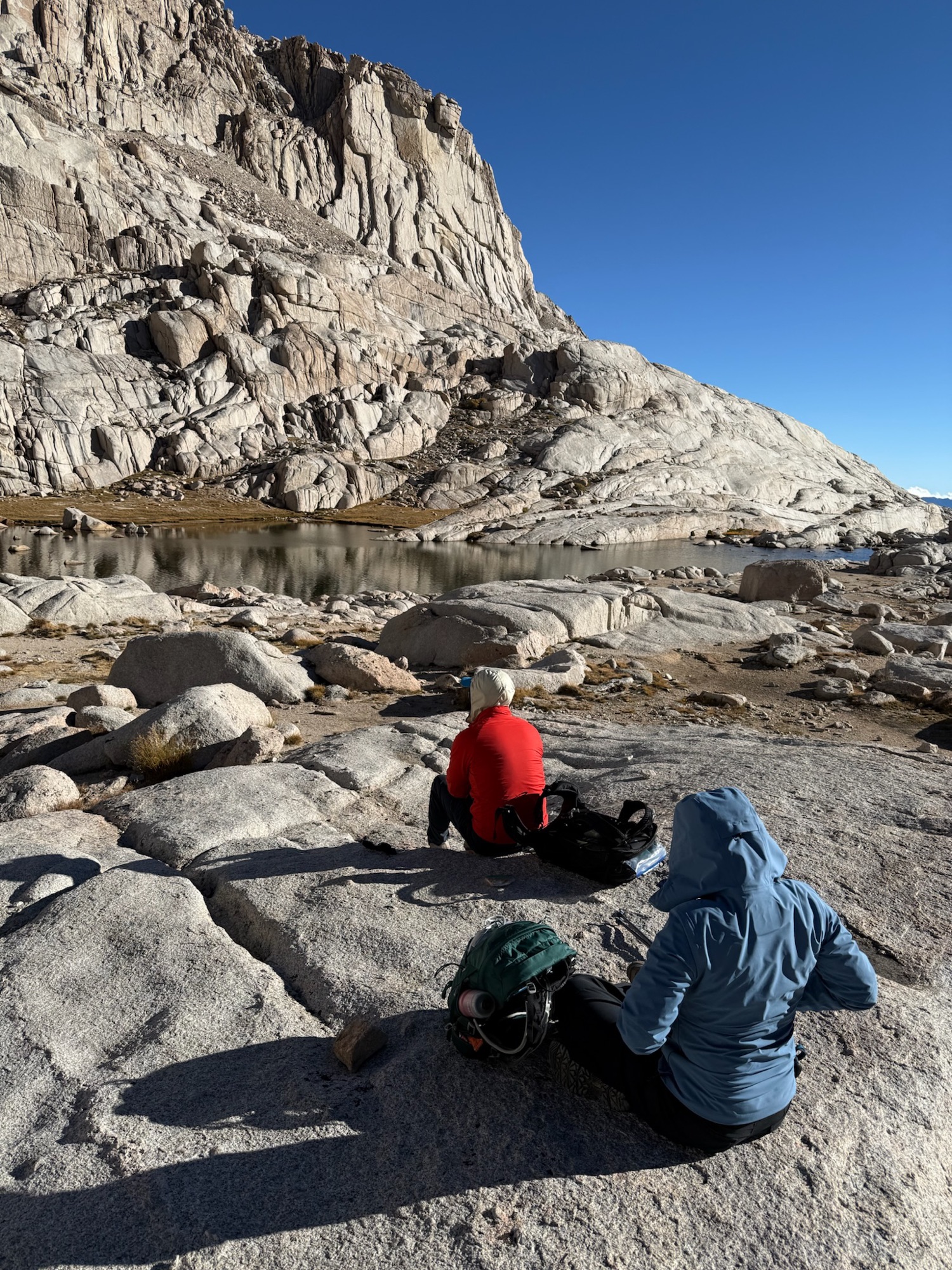
We take a short breather by a small lake and gird ourselves for what's to come.
We reach Trail Crest at 13,654 feet. It's significant on several fronts.
First, it marks the end of the 99 switchbacks and the start of the toughest leg: 2.8 miles to the summit.
Second, this is where blizzard conditions the day before forced hikers to abandon their summit bid. As you can see, there's little protection from storms or strong winds along the narrow ridge.
And third, this is roughly where Whitney and I turned back last year during our first attempt together. On that occasion, the altitude made Whitney feel ill. She was determined to push on, but I didn't think it was safe, so we descended.
She felt much better today.
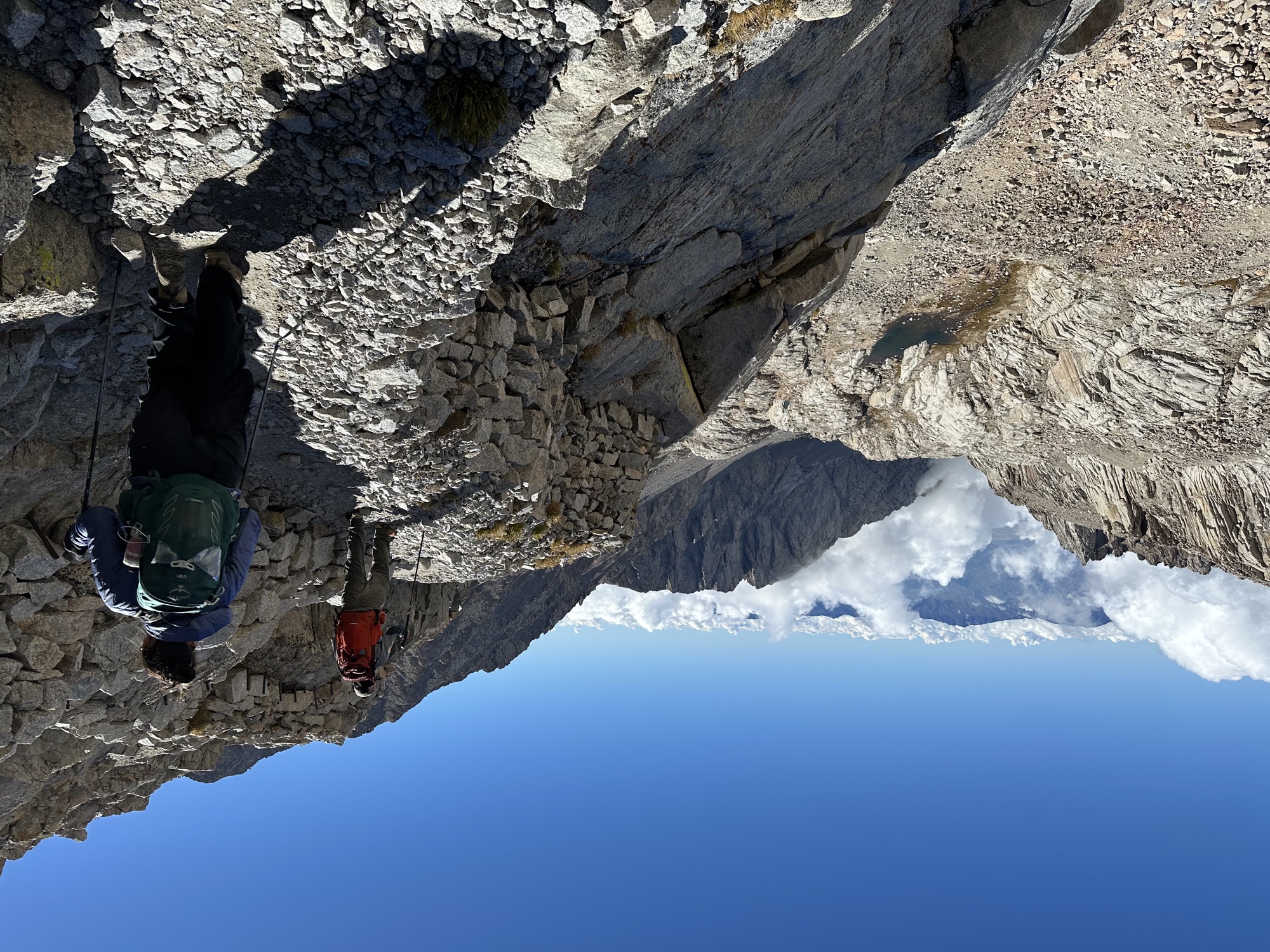
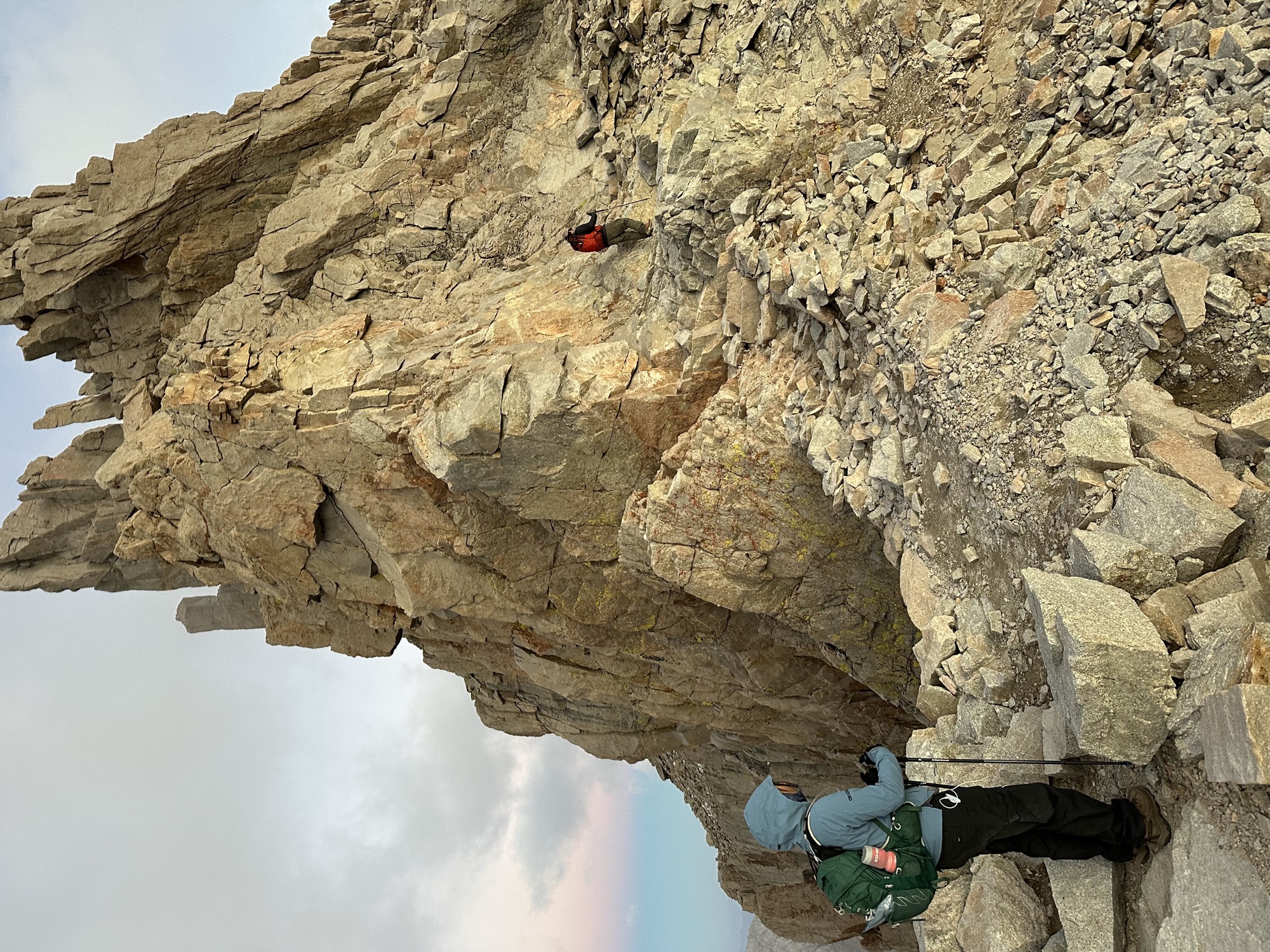
Remember when I said it gets a bit more risky above 12,000 feet? This is what I meant.
The video was taken about 4 feet from the middle of the trail. There are many steep drop-offs like this along the last leg.
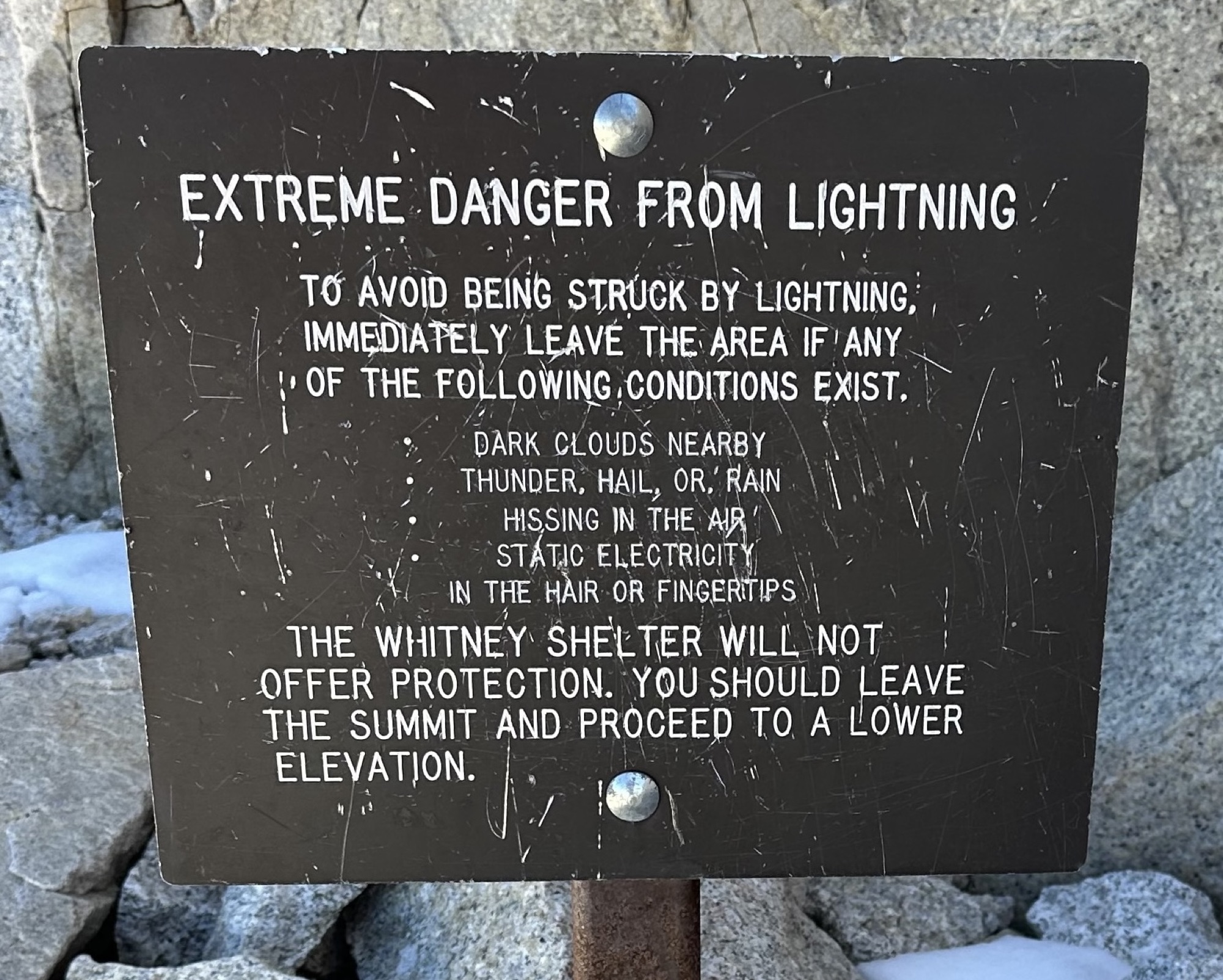
On top of that, if you see dark clouds coming, this sign below becomes more important. That hissing (bullet #3) may not be a snake.
We reach Trail Crest at 13,654 feet. It's significant on several fronts.
First, it marks the end of the 99 switchbacks and the start of the toughest leg: 2.8 miles to the summit.
Second, this is where blizzard conditions the day before forced hikers to abandon their summit bid. As you can see, there's little protection from storms or strong winds along the narrow ridge.
And third, this is roughly where Whitney and I turned back last year during our first attempt together. On that occasion, the altitude made Whitney feel ill. She was determined to push on, but I didn't think it was safe, so we descended.
She felt much better today.
Remember when I said it gets a bit more risky above 12,000 feet? This is what I meant.
The video was taken about 4 feet from the middle of the trail. There are many steep drop-offs like this along the last leg.
On top of that, if you see dark clouds coming, this sign below becomes more important. That hissing (bullet #3) may not be a snake.
For those who have never felt the enfeebling effects of high altitudes, hiking another 2.8 miles can feel insurmountable.
Each step takes effort and the breathing only gets harder as you climb above 13,500 feet.
Meanwhile, your brain tells you that you've gone too far to turn back, just as your body insists you still have much too far to go.
There's a delicate balance of pushing forward but not endangering yourself or the group.
Most of the time along the high, narrow ridge, you have the security of a rock wall on one side. But there are a number of short sections known as "windows" where there are no walls, and you feel a bit like you're walking a tightrope.
Granted, it's a tightrope that's roughly 6 feet wide, but if you're already feeling unsteady because of fatigue, it can be a little unsettling. It doesn't help that strong gusts of wind can blow through these windows.
For those who have never felt the enfeebling effects of high altitudes, hiking another 2.8 miles can feel insurmountable.
Each step takes effort and the breathing only gets harder as you climb above 13,500 feet.
Meanwhile, your brain tells you that you've gone too far to turn back, just as your body insists you still have much too far to go.
There's a delicate balance of pushing forward but not endangering yourself or the group.
Most of the time along the high, narrow ridge, you have the security of a rock wall on one side. But there are a number of short sections known as "windows" where there are no walls, and you feel a bit like you're walking a tightrope.
Granted, it's a tightrope that's roughly 6 feet wide, but if you're already feeling unsteady because of fatigue, it can be a little unsettling. It doesn't help that strong gusts of wind can blow through these windows.
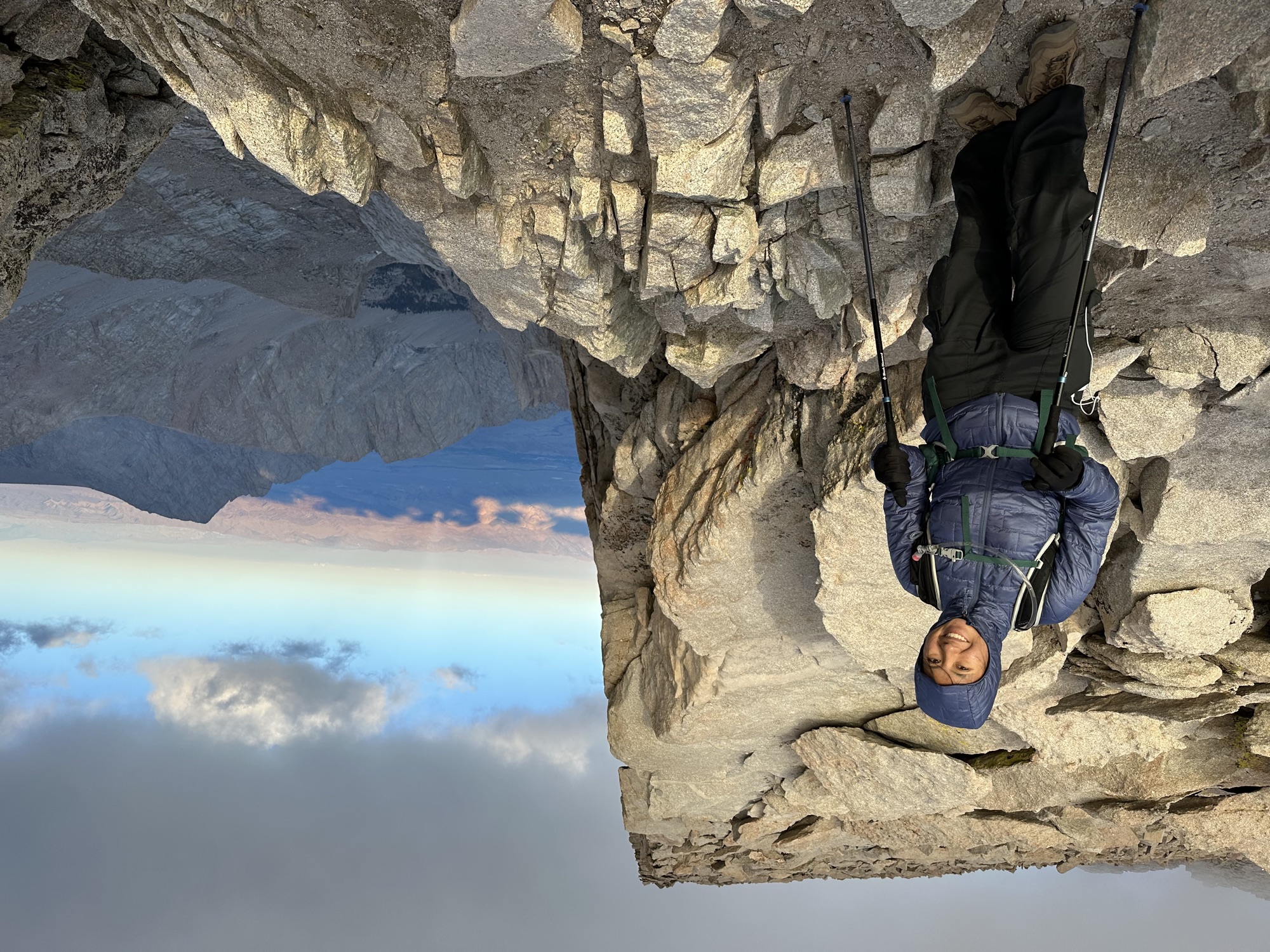
Whitney gives a thumbs-up, despite her fatigue from the altitude. She is digging deep into her well of resilience to reach the summit. We're at 14,047 feet with still about half a mile to go.
For the past mile or so, we've forced ourselves not to think about the total distance left. Instead, we focused only on the next 0.1 mile to cover. (The bigger the challenge, the smaller the pieces you need to chunk it into.)
Every couple hundred steps or so, I check my GPS map and give an update on whether we covered that 0.1 mile. Each time we do, it's a morale booster that fuels the next 0.1. This approach keeps us moving forward.
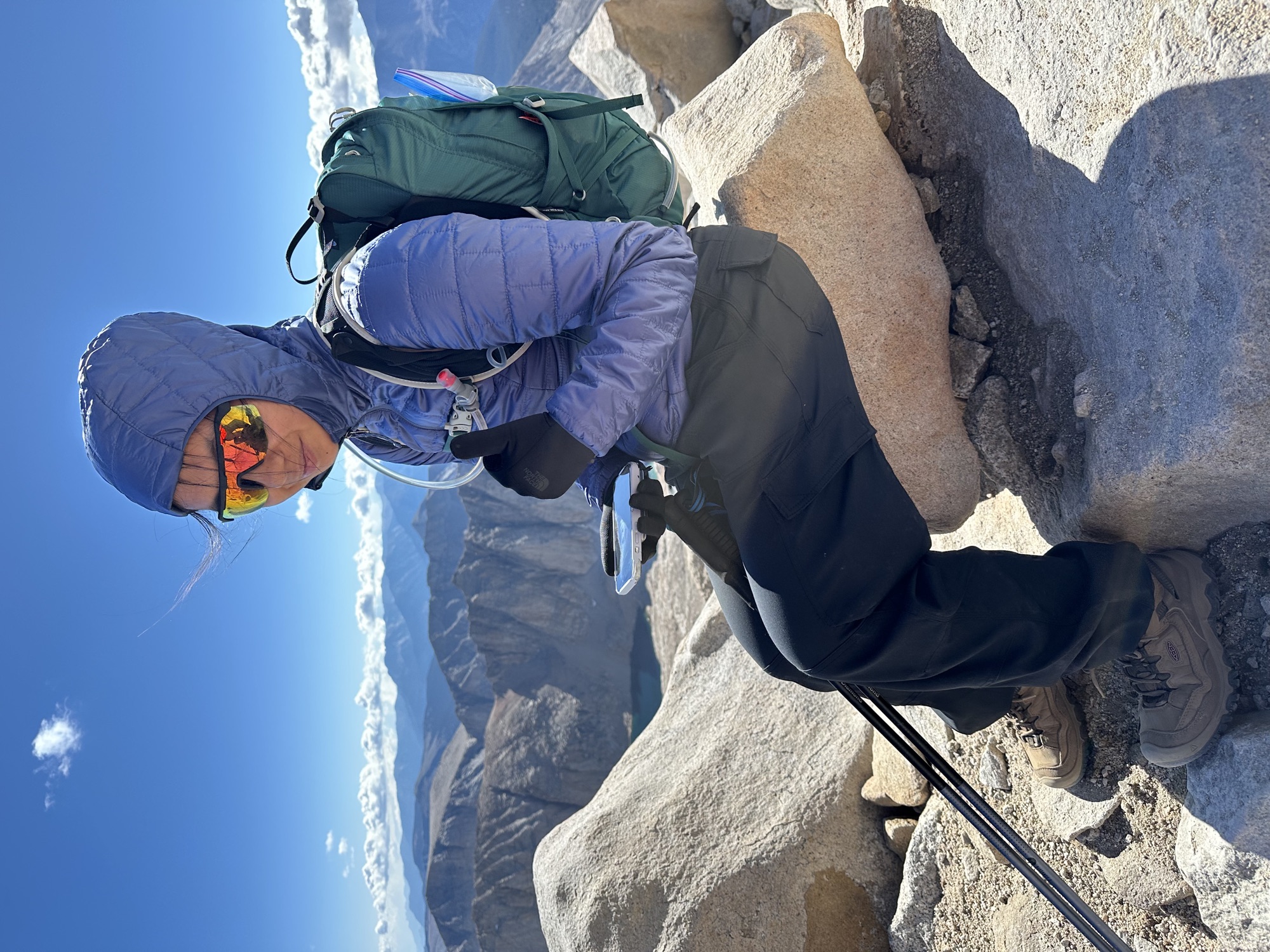
Whitney gives a thumbs-up, despite her fatigue from the altitude. She is digging deep into her well of resilience to reach the summit. We're at 14,047 feet with still about half a mile to go.
For the past mile or so, we've forced ourselves not to think about the total distance left. Instead, we focused only on the next 0.1 mile to cover. (The bigger the challenge, the smaller the pieces you need to chunk it into.)
Every couple hundred steps or so, I check my GPS map and give an update on whether we covered that 0.1 mile. Each time we do, it's a morale booster that fuels the next 0.1. This approach keeps us moving forward.
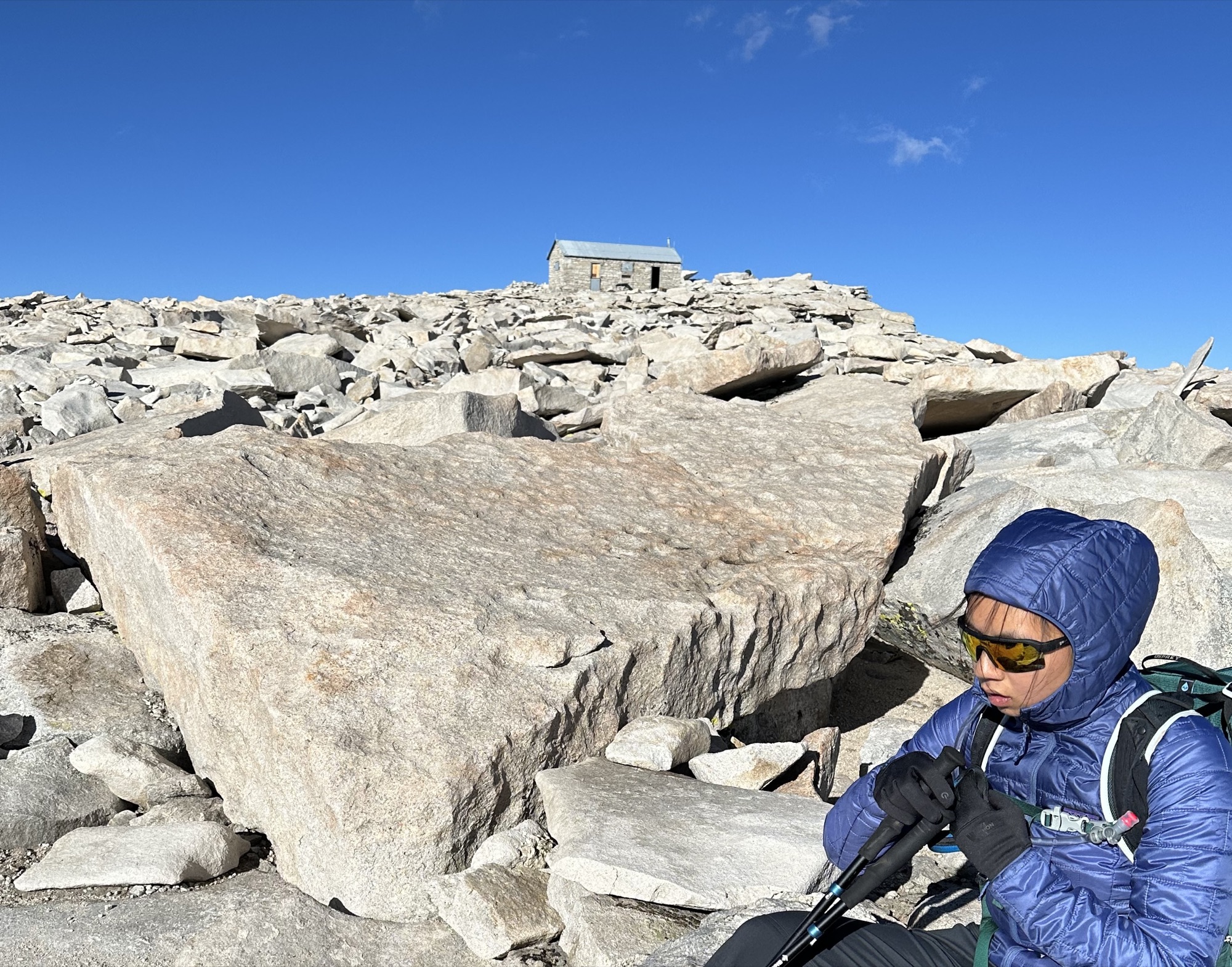
We see the hut. Officially known as the Smithsonian Institution Shelter, it represents the top of Mount Whitney. The finish line is now within view.
We run into Griffin who has already summited and is now descending. For much of the hike, he's had to fight his urge to move faster. So during the final leg, I tell him to go on ahead. I know the general rule is to stay together, but the path is straightforward near the end.
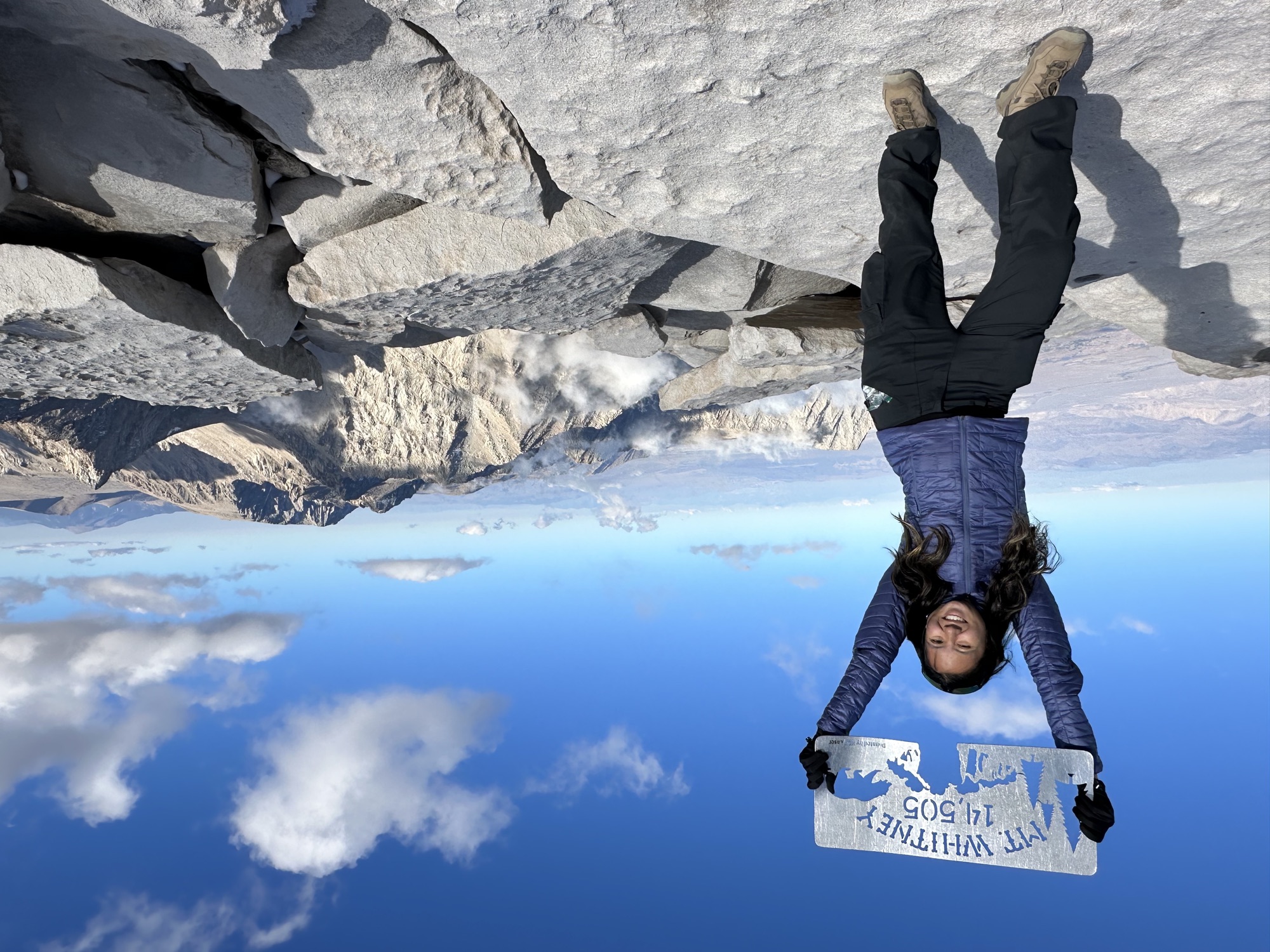
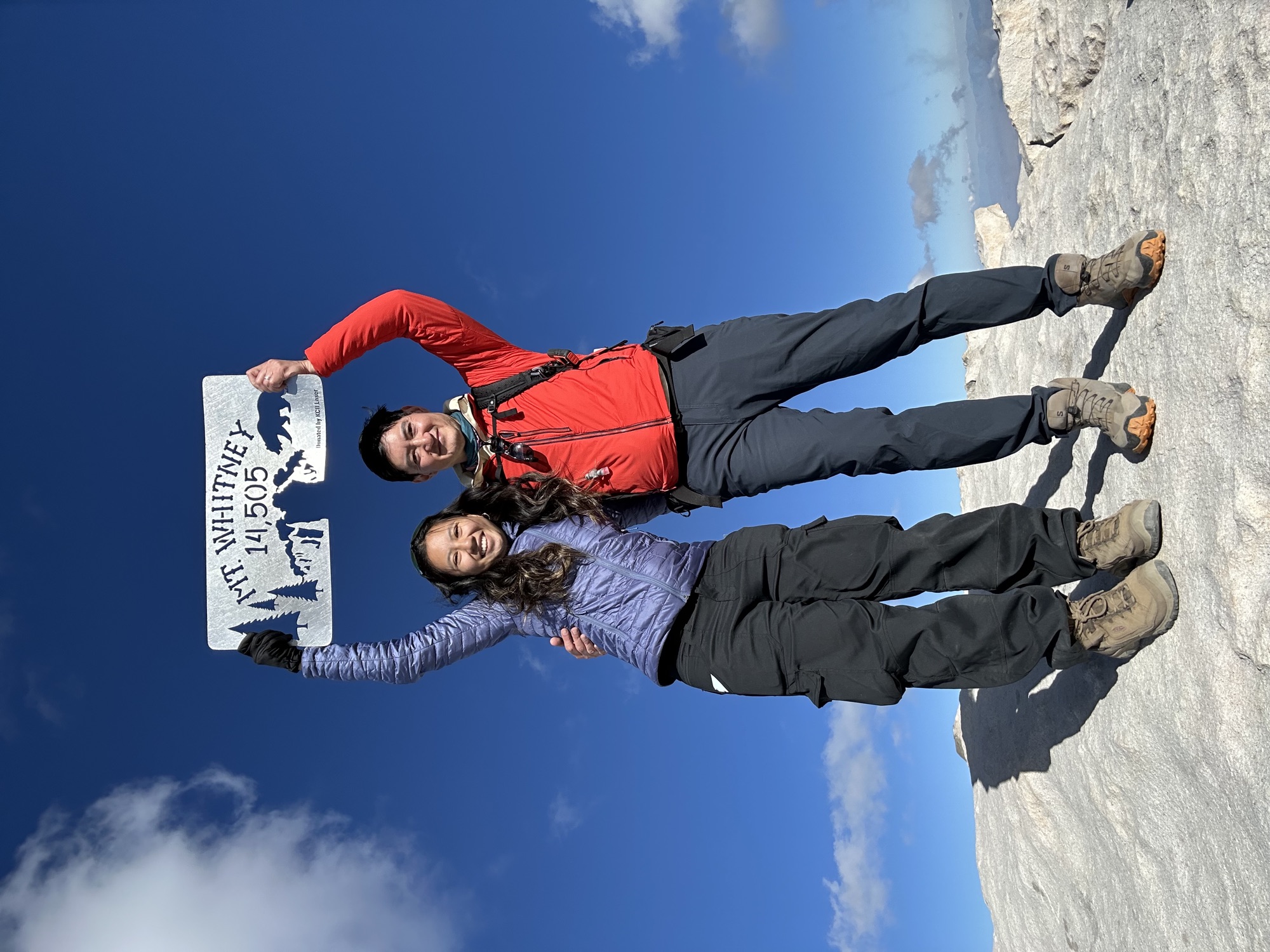
Whitney summits her namesake. It's a moment of intense emotion, exhilaration and exhaustion. She gives me the best hug I can remember.
It's the first fourteener for Whitney and Griffin. I'm proud of the fortitude they showed, and I'm grateful to have shared in their experience, albeit a grueling one.
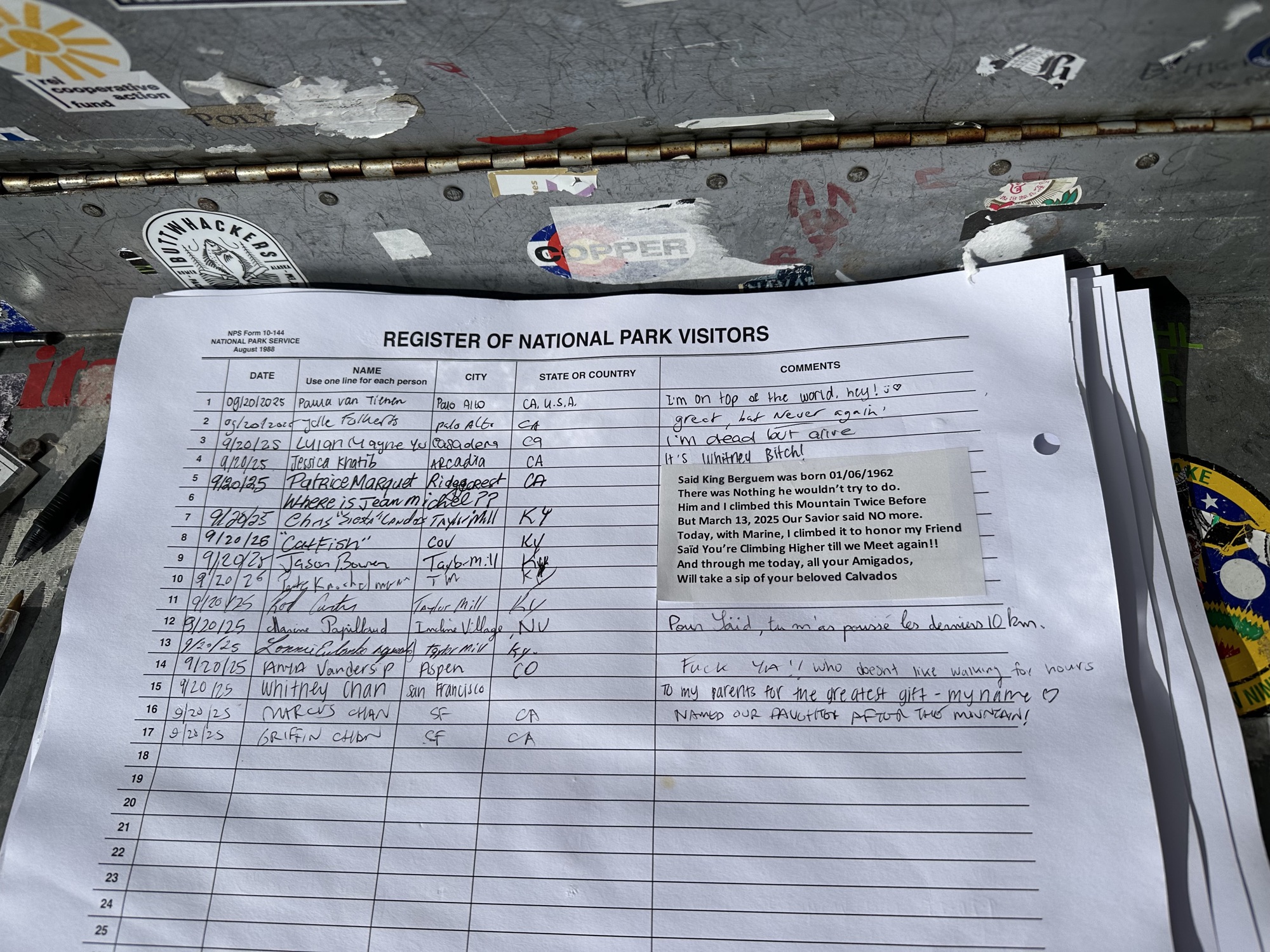
Whitney and I take our well-earned summit photos, leave our name on the wall of names and sign the registry. Then our focus quickly turns to our descent.
Whitney summits her namesake. It's a moment of intense emotion, exhilaration and exhaustion. She gives me the best hug I can remember.
It's the first fourteener for Whitney and Griffin. I'm proud of the fortitude they showed, and I'm grateful to have shared in their experience, albeit a grueling one.
Whitney and I take our well-earned summit photos, leave our name on the wall of names and sign the registry. Then our focus quickly turns to our descent.
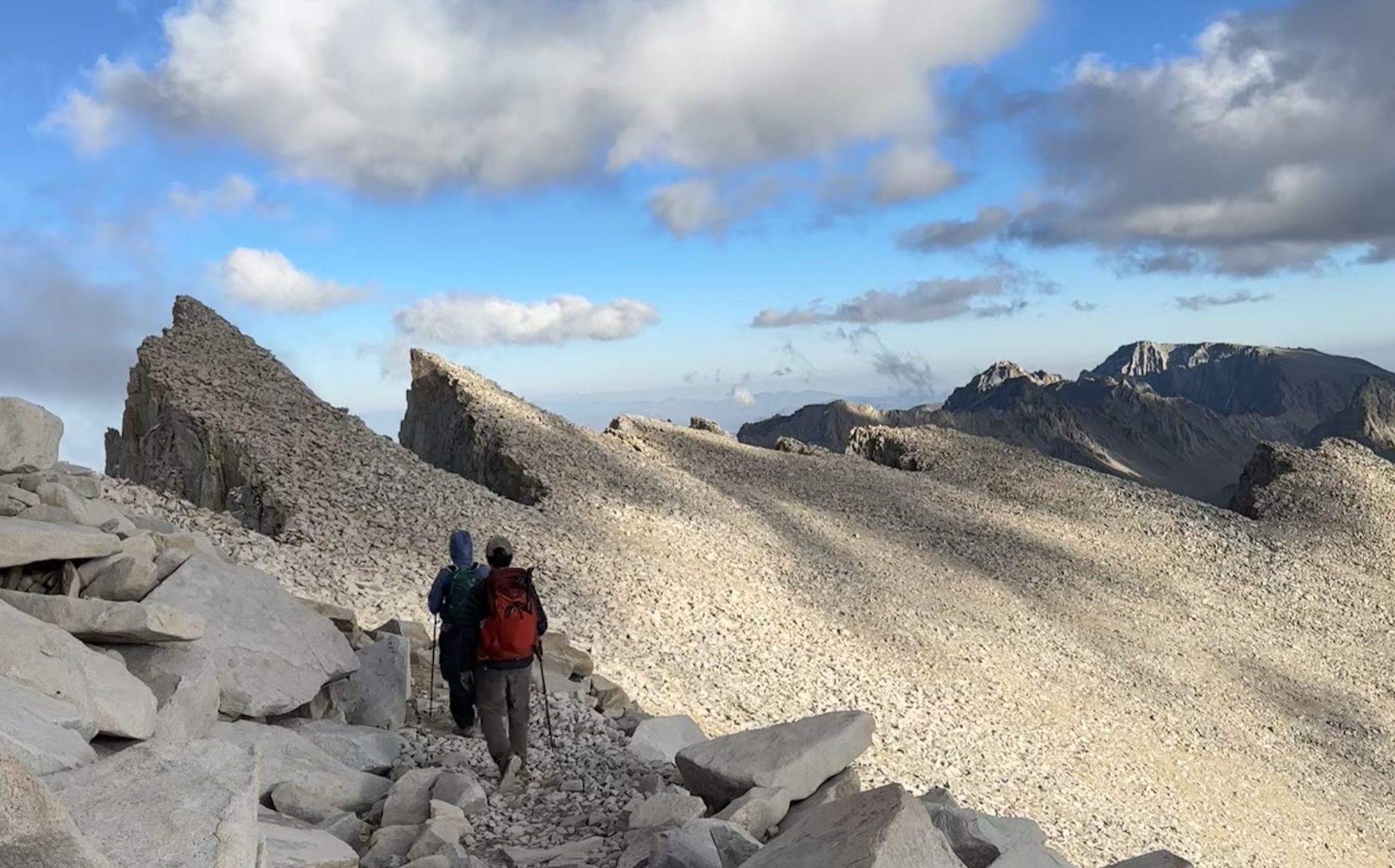
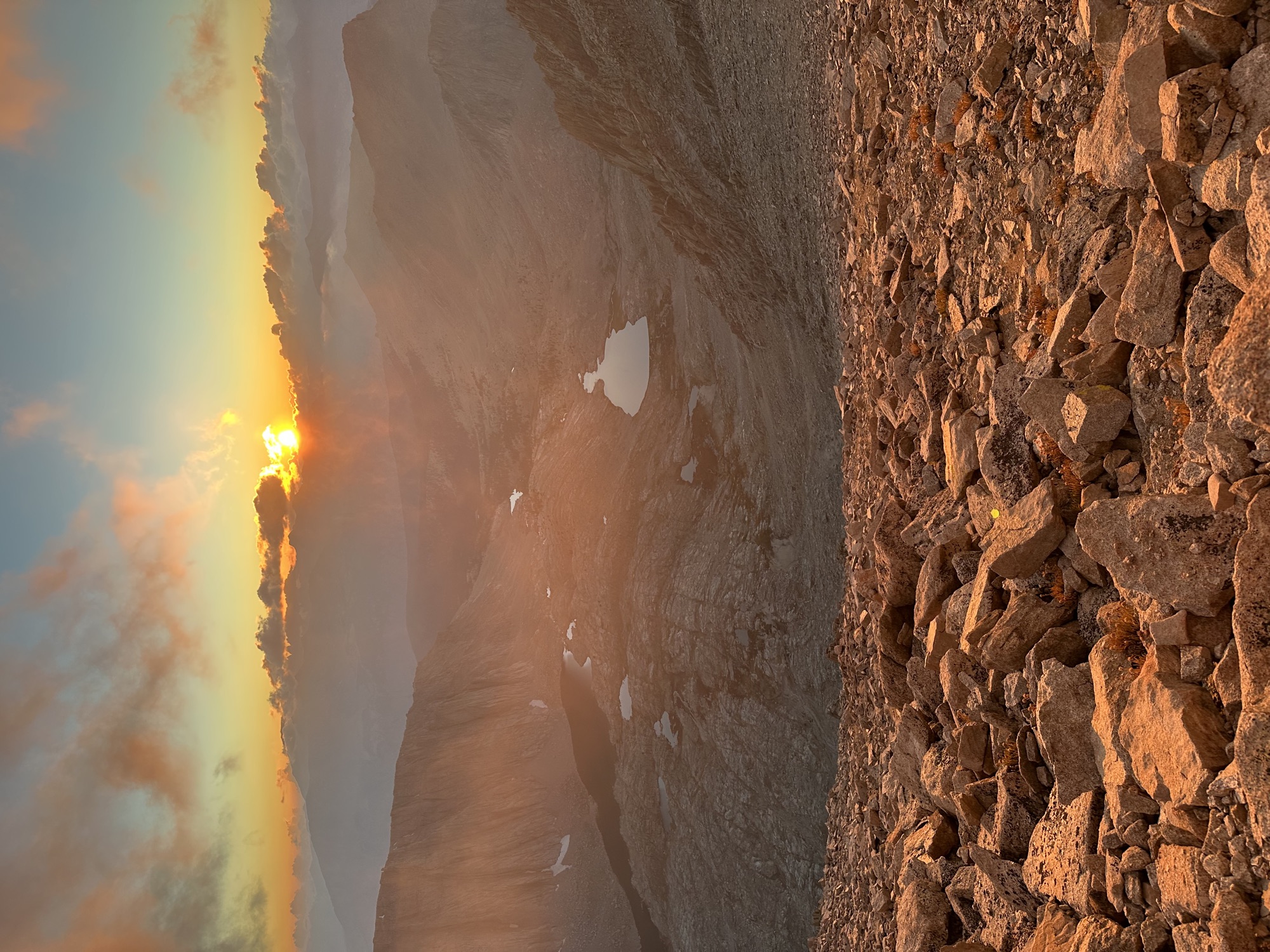
We begin our descent and try to cover as much ground as we can before the sun goes down. Once we lose light, trails can disappear and the chances of something bad happening increase greatly.
The clouds begin to reach us, but I'm amazed at how calm they are. The winds continue to softly blow. Everything is so peaceful. We've been so lucky with this weather.
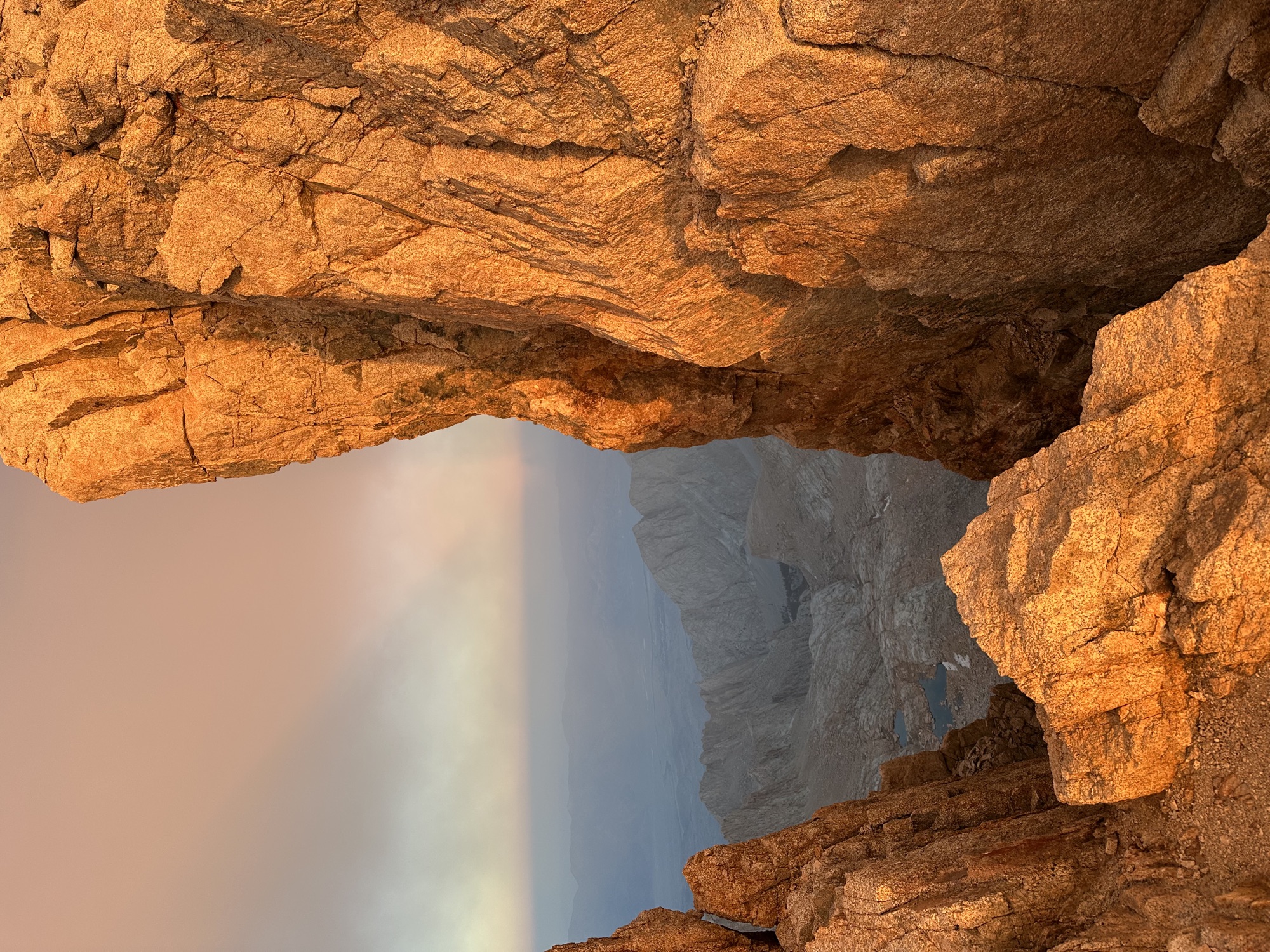
As the sun begins to set, the colors change from a soft white to an amber to a cool blue-gray. Mother Nature puts on a stunning light show. I wish we could enjoy it, but darkness is coming.
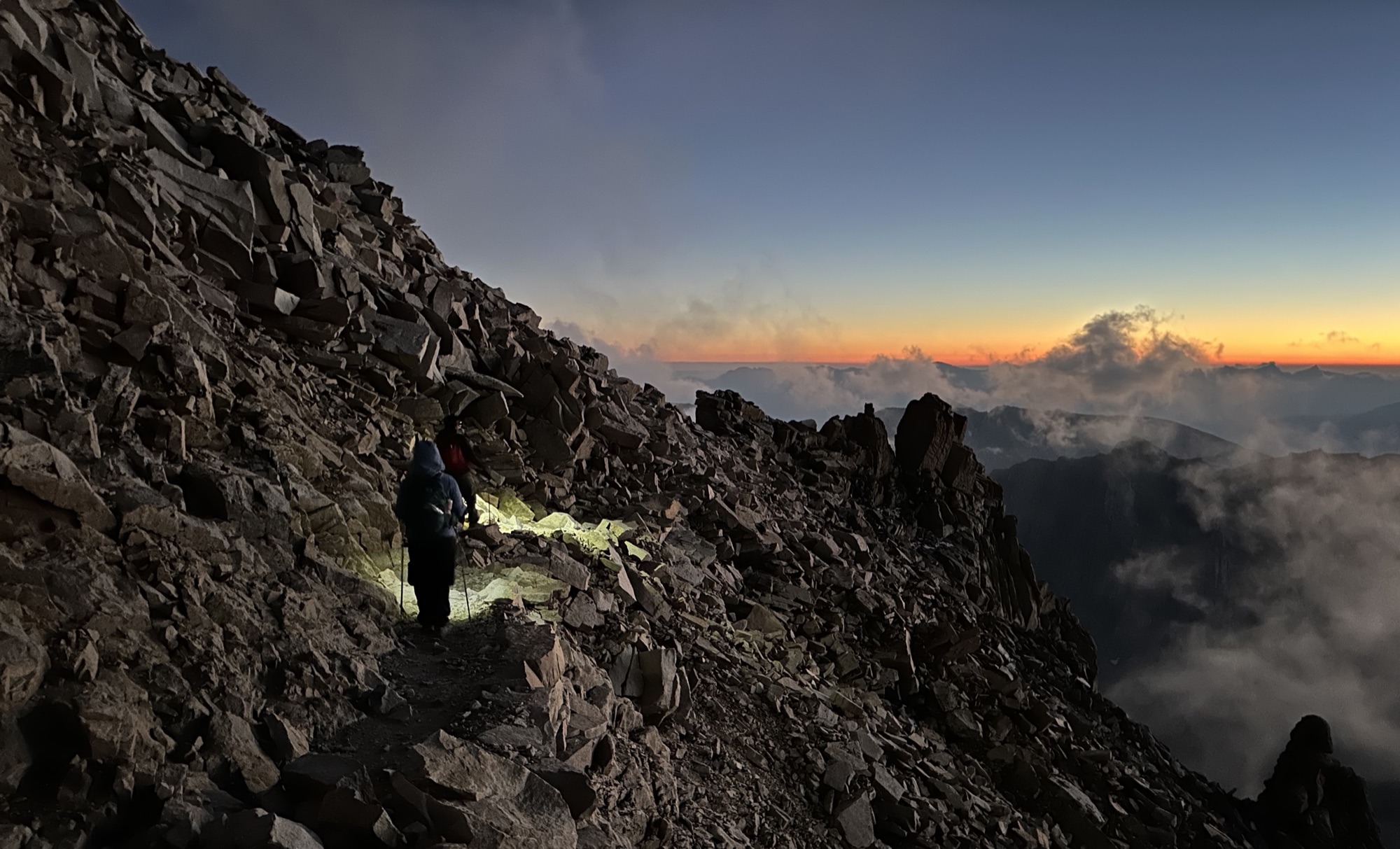
Our headlamps are on again. We're not close to the 99 switchbacks.
The altitude starts to hit me. We've been descending for more than an hour, but we're still above 13,500 feet. I have a slight headache and feel cold, even though I have five layers on.
At one point my kids tell me to rest, but I tell them that the only thing that's going to make me feel better is descending. At this point, 11,000 feet sounds really good.
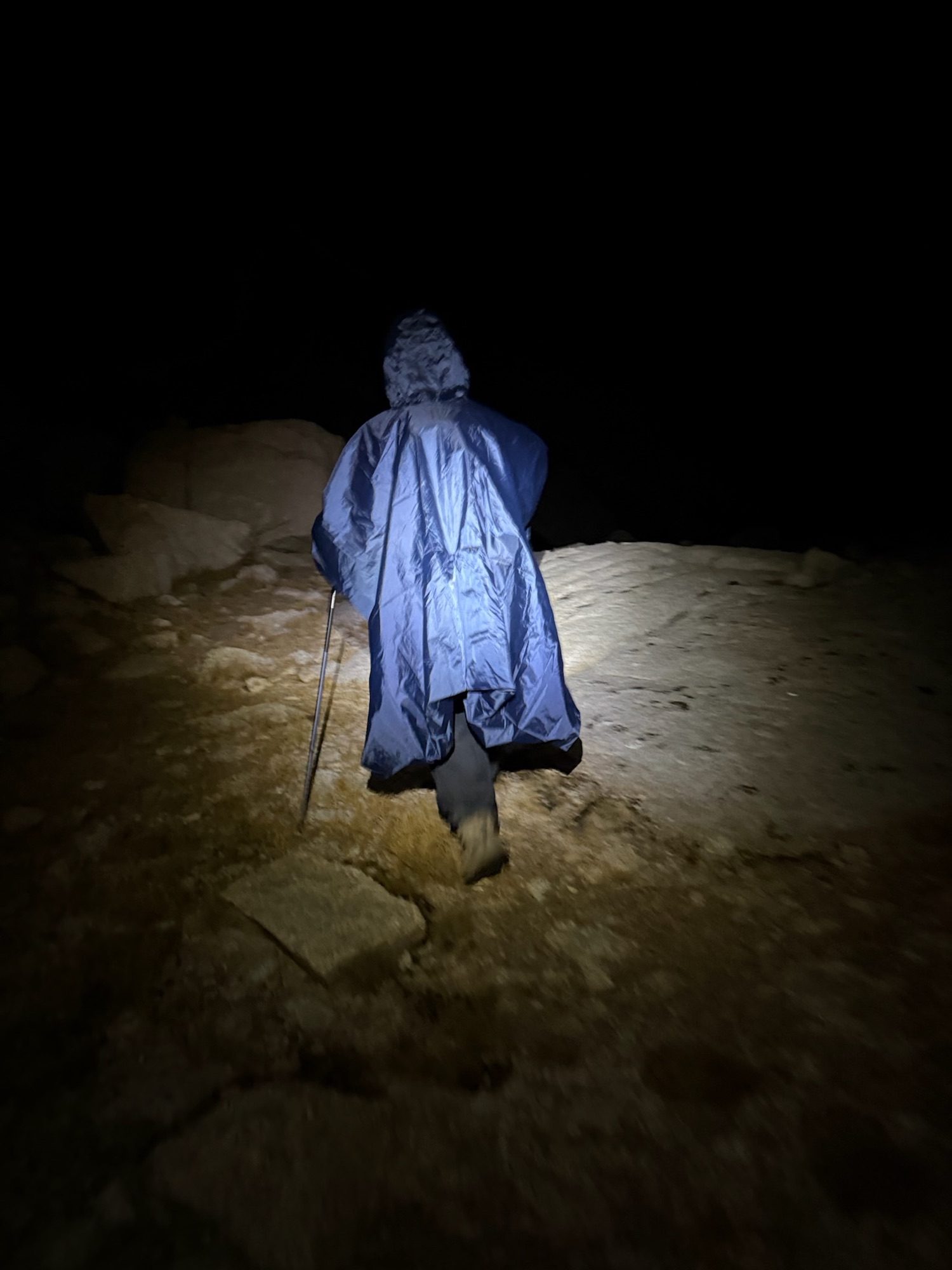
It was going to be a long day no matter what. Typically, if you're doing the whole trail in one day, it takes around 14 to 16 hours (roughly the amount of time it took me and my friends when I summited years ago). You're not expecting to go for 24-plus hours. That would be nuts. But that's what happened.
As we descend below 12,000, Whitney and Griffin get their second wind. Not me. I'm dry heaving. At one point, my exhaustion causes me to lose balance and I fall on my left side. Weirdly, I bounce right back up, so we keep moving.
Thanks to the darkness and our fatigue, we make a couple of wrong turns. There's nothing more discouraging than needlessly adding time and distance to your footslog, but it happens.
This is one of only two photos taken during the last 8 miles because we were focused on only one thing: getting off this mountain.
It was going to be a long day no matter what. Typically, if you're doing the whole trail in one day, it takes around 14 to 16 hours (roughly the amount of time it took me and my friends when I summited years ago). You're not expecting to go for 24-plus hours. That would be nuts. But that's what happened.
As we descend below 12,000, Whitney and Griffin get their second wind. Not me. I'm dry heaving. At one point, my exhaustion causes me to lose balance and I fall on my left side. Weirdly, I bounce right back up, so we keep moving.
Thanks to the darkness and our fatigue, we make a couple of wrong turns. There's nothing more discouraging than needlessly adding time and distance to your footslog, but it happens.
This is one of only two photos taken during the last 8 miles because we were focused on only one thing: getting off this mountain.
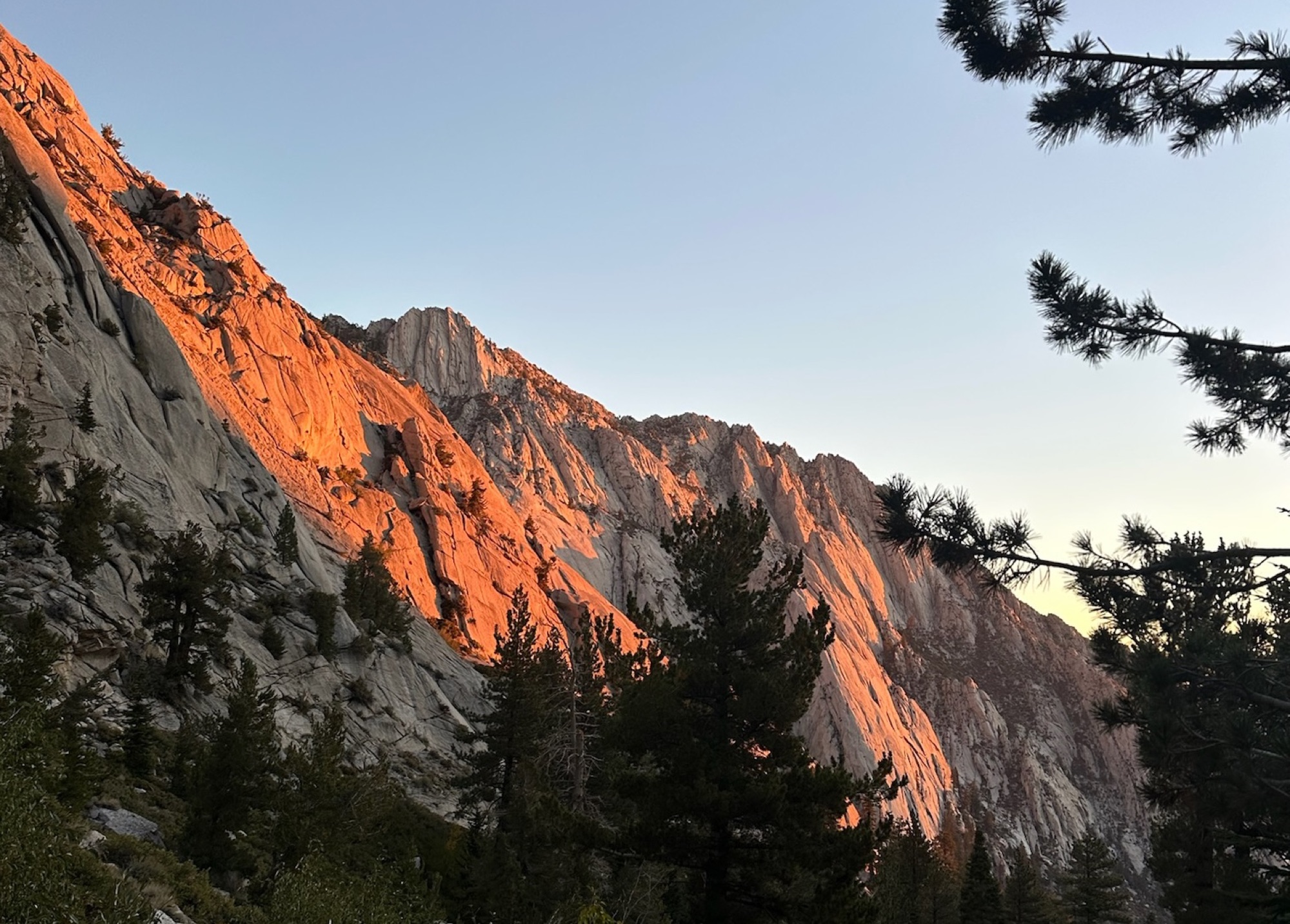
You know it's a long hike when you get to see the sun rise — twice.
I've been on death hikes before, but nothing like this. For each of us, it was such an intense experience that even months later, we continue to process and draw perspective, lessons and inspiration from it.
Was it humbling? Clearly. Many hikers do the 22 miles in half the time. But even so, it was also confidence-building. Pushed to our limits, we kept our wits and forged ahead.
This wasn't the challenge we expected, but it was the challenge we got. And we rose to it.
All 14,505 of it.